

Twenty-Seven Sticky Notes on My Fridge Door, and the Board That Replaced Them

Forty years of hospital shifts ran on a task board. At home, hers became a snowdrift of yellow paper. The small lit board a friend brought over, read line by line: what it does, what it doesn't, what it costs.
On a Tuesday morning in April, I stood in front of my refrigerator with a cup of coffee and counted the sticky notes on the door.
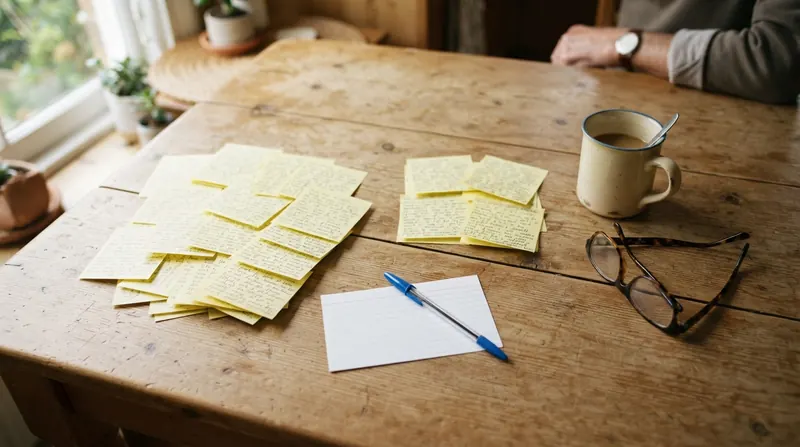
There were twenty-seven. Two more were on the floor, face down, which is where yellow paper goes when the glue gives up.
I'm not a woman who panics at a number. For forty years I worked twelve-hour shifts on a surgical floor in a county hospital outside Dayton, Ohio.
 From the Fridge Door · No. 27
I've counted worse things than sticky notes at seven in the morning. But I had never once counted them on my own refrigerator.
So I did what I did every morning of my working life when the night shift handed me a mess.
I read the board, top to bottom, slowly, with my finger on each line.
"Feed Biscuit (ONCE)." "Trash night = TUES."
"Call Carol Sun 4pm." "Water tomatoes."
"Back door?" That last one had a question mark, and it had been there since February.
Underneath, in different ink, a second note said "Back door — YES, checked." And underneath that, a third one said "Did you?"
I stood there and laughed out loud, because my refrigerator had turned into the worst charge desk I had ever worked at.
Twenty-seven orders, no times on half of them, no way to tell which ones were done. And the only person on shift was me.
Forty Years of Shifts, and the Board at the End of the Hall
To understand why that refrigerator bothered me so much, you have to know about the board.
Every floor I ever worked on had one. Ours hung behind the desk at the end of the hall:
a big white dry-erase board with a black grid ruled on it in tape.
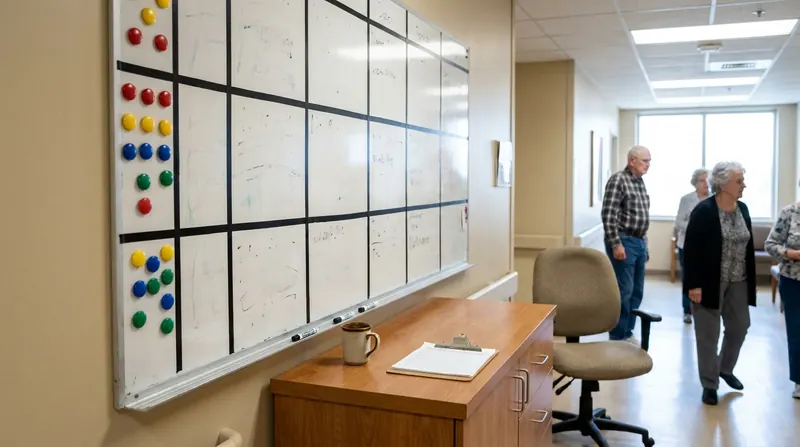
Down the left side were the room numbers. Across the top were the times.
In each square went the thing that had to happen, and who was doing it.
On a good night, I had ten rooms. Ten rows of squares, ten people in ten beds, and every square on that board was a promise somebody had made.
Here's the part nobody outside a hospital knows. The board wasn't there because we were forgetful.
It was there because nobody, not the sharpest person on the floor, can hold forty small promises in her head across twelve hours and a dozen interruptions.
The board held them for us. Our heads were for the people in the beds.
When something was done, you went to the board and you marked it. A check, a magnet moved, a line through the square.
You didn't trust your memory of having done it, because at four in the morning your memory of doing something and your memory of meaning to do it look exactly alike.
That sentence is the whole reason I'm writing this column. Your memory of doing something and your memory of meaning to do it look exactly alike.
I knew that at thirty. I'd forgotten it by sixty-seven, because I'd retired, and I thought I'd left the board at the hospital.
The Board Followed Me Home, One Sticky Note at a Time
I retired in the fall of 2021.
There was a sheet cake with a stethoscope drawn on it in blue icing, and Loretta, our unit clerk for thirty-one years, made a speech that made me cry in front of the residents.
Then I went home to Gene, who had retired from the post office four years before me and had been waiting very patiently for someone to talk to at lunch.
The first year was wonderful. I slept past five.
I planted tomatoes. I learned that our cat, Biscuit, has a schedule of her own and expects it to be honored.
The second year, the days began to run together, the way days do when no one hands you a report at seven o'clock.
Monday looked like Thursday. Trash night arrived and left without our bins at the curb, twice in one month.
My sister Carol called from Tucson one Sunday and said, "I've been sitting by the phone since four." It was the first Sunday call I'd missed in nineteen years.
None of that is unusual. I want to be very plain about that, because this isn't a scary column.
It's a column about the ordinary, everyday slippage of a day that has nobody running the board.
And the slippage had a shape, the way slippage always does on a floor. It wasn't the big things.
It was the small, repeated, did-I-or-didn't-I things.

Biscuit got breakfast twice. Not once, a lot.
Gene fed her at six because she was yelling, and I fed her at seven because she was still yelling, and neither of us knew the other had done it.
At her checkup that fall, the vet weighed her and raised one eyebrow. Biscuit had gained a pound and a half, which on a cat is a lot of second breakfasts.
The back door got checked three times a night. I'd lock it at nine, go to bed, lie there, and not be able to see myself locking it.
So I'd get up and check. It was always locked.
Some nights I'd check again at eleven, because by then the nine o'clock check had gone gray too.
The tomatoes got watered twice on some days and not at all on others. By August, half of them had split on the vine.
And then there were the moments that weren't tasks at all. The word on the tip of the tongue at the hardware store.
The keys that had moved from the hook to the pocket of a coat I hadn't worn since March.
The name of our neighbor of thirty years, Stan, who has waved to me across the driveway every single morning since 1994.
I stood at the mailbox one morning with my hand up, waving back, and the name simply wasn't there for about four seconds.
It came back. It always came back.
"Morning, Stan," I said, a little too loudly, and he said, "Morning, Marian," and went back to his paper.
But I went inside and sat down at the kitchen table for a while with my coffee getting cold.
Then I wrote "STAN" on a sticky note, for no reason I could explain, and stuck it on the fridge.

How Twenty-Seven Notes Happen
Nobody decides to put twenty-seven sticky notes on a refrigerator. It happens the way a cluttered board happens on a floor: one urgent square at a time, and nobody ever erases.
The first note went up in the winter of 2023. "Trash night = TUES," in black marker, because we'd missed it twice.
The second was "Feed Biscuit (ONCE)," after the vet. Gene put that one up, and he underlined ONCE three times, which tells you who he thought the problem was.
Then "Call Carol Sun 4pm." Then "Water tomatoes."
Then the back door, and then the note about the back door note.
By spring of this year, the notes had their own geology. The bottom layer was faded and curled.
The top layer was bright yellow and urgent.
And here's what any charge hand could have told you was coming.
A board with no times, no order and no way to mark a square done isn't a board; it's a pile.
The notes told me what I had to do. They never told me when, and they never, ever told me whether I'd already done it.
So every note was always "on." Twenty-seven orders, all live, all the time.
I'd walk past the fridge and feel the whole door looking at me.

That's the note I'd frame if I framed anything. Three notes, two hands, one door, and not one of them could tell you whether the back door was locked.
Gene wrote the third one. When I asked him about it, he said, "I wasn't sure if you'd checked or if you'd written that you'd checked."
He was right, and that's the trouble. On a fridge, "I did it" and "I meant to" are written in the same ink.
Mom, did you send the birthday card to Aunt Carol? Her birthday's Thursday.
6:18It's on the fridge. Somewhere between the tomatoes and the back door.
6:31Is that a yes?
6:32It's a note that says "Carol card." I honestly can't tell you if that means I did it.
6:40I sent the card that afternoon. It turned out I'd already bought one and put it in the drawer by the phone, stamped.
Carol got two cards and called to ask if I was trying to tell her something.
That's when I decided the refrigerator needed a charge hand.
I just didn't know yet that the charge hand was going to arrive in a shopping bag, carried by the same woman who used to run the board on my floor.
The Unit Clerk Who Ran Our Board for Thirty-One Years
If you've never been in a hospital at shift change, you may not know what a unit clerk is. I'll tell you: she's the person who actually runs the floor.
Loretta Haskins sat at the desk at the end of our hall from 1988 until 2019. She answered the phones, kept the charts in order, and kept the board.
Residents came and went. Managers came and went.
Loretta stayed, and the board was always right, because Loretta didn't believe in a square that wasn't marked.
She's seventy-two now, a widow, living in a brick ranch house in Centerville, twenty minutes from me.
We have lunch on the first Thursday of the month, and we have since she retired.
In May, it was my turn to host. Loretta walked into my kitchen, set her purse on the counter, and stopped dead in front of the refrigerator.
She didn't say anything for a long moment.
Then she took her reading glasses out of her cardigan pocket, put them on, and read the door, top to bottom, with her finger on each note.
I'd seen her do exactly that to the board at the end of the hall ten thousand times. It was like watching someone read your diary out loud.
"Marian," she said finally. "Who's charge on this floor?"
"Me," I said.
"Then why," she said, tapping the "Did you?" note, "can't anybody on this floor tell me if the back door is locked?"

We laughed about it over lunch. Then, over the second glass of iced tea, Loretta told me about her own kitchen.
After Walt passed, she said, her days lost their edges. Walt had been her board.
He'd say "Did you eat lunch?" and "Garbage tonight, Lor," and she'd never needed a list.
Without him, she found herself standing in the kitchen at two in the afternoon, unable to say whether she'd eaten lunch. Not because anything was wrong.
Because nobody had asked.
Her son, who lives in Indianapolis, had wanted to set her up with a talking speaker and a phone app and a camera in the living room.
Loretta, who once kept a forty-bed floor running on a whiteboard and four colors of marker, said absolutely not.
"I don't want something that talks to me," she told him. "I don't want anything watching me.
I want the board."
So her son went looking for a board. And what he found, after some back and forth, was a little desk clock with a handwritten list on it, called the Day Hub.
That last line is the one that got me. It's the board.
She had brought the instruction booklet in her purse, because of course she had.
Loretta has never in her life recommended anything without the paperwork.
Did you read the booklet or did you put it on the fridge with the others?
8:02I read it twice. It's on the table. The fridge is full.
8:05Ha. Come see mine Thursday. Mine went green at noon today. Lunch, eaten, marked.
8:06Bringing my reading glasses and a pen. I'm auditing it first.
8:09What a Board Looks Like in Somebody Else's Kitchen
On the first Thursday of June, I drove to Centerville with my pencil list and my reading glasses.
Loretta's kitchen is small and yellow, with a window over the sink that looks out on a bird feeder Walt built in 1997.
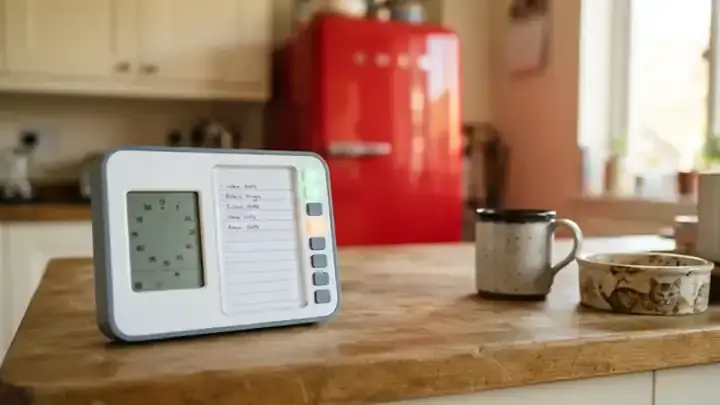
The clock sat on the counter between the bread box and the radio, angled toward the kitchen table. You could read the day and the time from the doorway.
It said "Thursday," and under that, "Afternoon," and under that the time. I hadn't realized how much I'd missed seeing the word "Afternoon" written down for me.
On a floor, you always know what part of the day it is, because the whole building changes shape around you. At home, two o'clock and four o'clock can feel exactly alike.
Her card was written in the same blocky capitals she used on our board for thirty-one years. I would have known that handwriting anywhere.
"BIRDS 7:00." "BREAKFAST 7:30."
"LUNCH 12:00." "WALK TO MAILBOX 2:00."
There were only seven lines filled in.
"Seven?" I asked her.
"You've got ten buttons."
"I've got seven things," she said. "A board with empty squares is a good board.
It means somebody planned the shift."
The top four buttons were green. The fifth, the mailbox walk, was dark, because it wasn't two o'clock yet.
While we ate, it turned two, and a small tone sounded, and the fifth button went orange. Loretta didn't jump up.
She finished her sandwich, put on her shoes, walked to the mailbox and back, and pressed it.
Green. She didn't say anything about it.
She didn't have to.
I drove home that afternoon thinking about the words "a good board." Mine wasn't a board at all.
Mine was a door.
The Seller's Page, Read Like a Shift Report
I didn't buy it that week.
I want to be clear about that, because I've never once in my life bought something just because a friend told me to, not even when the friend was Loretta.
What I did instead was the thing I did at the start of every shift. I took report.
I sat down with the seller's product page, the instruction booklet Loretta lent me and the store's policies, and I read them line by line, the way you read the chart of someone you're about to be responsible for.
Here is what the report says, in plain words, as it reads in October 2026. I've left out the adjectives.
What it is. A plastic desk clock about the size of a hardcover book: 9.7 inches wide, 7.2 inches tall and a little over an inch deep.
It has a folding stand at the back, rubber feet, and two holes if you'd rather hang it on the wall. It plugs into the wall on a six-foot cord.
The left half: the clock. A 7-inch screen, tall and narrow, that shows four things in big black letters.
The day of the week, the part of the day, the time and the full date.
The part of the day is the one I didn't expect to care about. It says "Morning," "Afternoon," "Evening" or "Night," right under the day.
The booklet gives the hours for each: morning from 4:00 a.m. to 11:59, afternoon from noon to 5:59, evening from 6:00 to 9:59 at night, and night from 10:00 p.m.
to 3:59 in the morning.
There are four color choices for the screen: black on white, black on yellow, white on black and yellow on black.
There's no setting to make the letters bigger, so what you see in the photos is what you get.
The right half: the board. This is the part Loretta meant.
There's a card, about the size of an index card, ruled into ten lines.
On each line you write a time and a task, in your own handwriting, with an ordinary pen. Then the card slides back in under a clear plastic cover.
Beside each line, on the right edge, is a square button with a check mark on it. Ten lines, ten buttons.
You set the times on the clock itself, using three buttons marked Menu, OK and Back. The box comes with five spare cards, for when you change your mind or your handwriting.
What happens at the set time. In the booklet's words: "When a task is due for completion, the corresponding Task Button will flash orange, and an audible alert will sound."
You do the thing, and you press the button. "It will then glow green."
Anything you haven't done stays orange. If you do something early, you can press its button ahead of time and the alert won't sound when the time comes.
And at three in the morning, every night, the whole board resets to start the next day fresh.
I read that sentence and put my coffee down. A board that resets itself at three in the morning is a night shift that never forgets to erase.
Power. It needs the wall outlet.
There's a small coin battery inside, a CR2032, but the booklet is clear that it's only there to save your settings if the power goes out, not to run the clock.
That battery, according to the booklet, is good for eight to ten years. I'll be eighty-something by the time I need to think about it.
Wi-Fi. This surprised me.
There's optional Wi-Fi, but in the seller's words it only syncs the time and date and lets the clock get software updates.
"This device will perform all functions perfectly out of the box, and without connecting to your Wi-Fi network." I never connected mine.
Daylight saving. The listing says it "automatically updates for daylight savings."
In our house, changing the clocks twice a year is a two-day project with a stepladder, so I wrote that one down.
Shipping. The seller says everything for the American store is dispatched from the US.
Standard shipping is $3.99, and it costs nothing on orders over $35, which this one is.
The company. Relish is a trading name of Active Healthcare Solutions Ltd, a company registered in England, with its registered office at 72 Leonard Street in London.
The American store has a US customer support phone line, 540-405-8541, and an email, info@relish-life.com.
I'll be honest about the one thing in the report I didn't love. The seller doesn't publish a street address in the United States, only that orders ship from here.
If a US address matters to you, that phone number is where you'd ask.
Read the Negatives First, the Way You Read Allergies
On the floor, before you read anything else on a chart, you read the allergies. What the person can't have matters more than what they're getting.
So here's the Day Hub's allergy list. I'd put it at the top of the box if I were the seller.
It doesn't talk. There is no voice.
At the set time a tone sounds and a button glows orange, and that's the whole announcement.
The screen doesn't tell you which task is due either. You look at the orange button, and you read the line written beside it in your own hand.
For Loretta, that was the selling point.
For somebody who wants a voice in the kitchen saying "Time for lunch, Marian," this is the wrong clock, and I'd rather you know that now.
It can't be set from far away.
The seller's own answer to that question: "The current design requires tasks to be input directly on the device.
There is no remote access feature for caregivers."
There's no app, no phone pairing and no touchscreen.
If your daughter lives in another state, she sets it up on her visit with a pen, and any changes wait until the next visit, or until you change them yourself.
It only does daily. Ten tasks, at the same times, every single day.
The seller says plainly that it's "not intended for managing appointments or events that occur on a weekly or monthly basis."
So trash night, which is Tuesdays only, cannot go on the card. Neither can my sister's Sunday call, or the dentist in three weeks.
Three of the reviewers I'll show you later said the same thing, one of them crossly.
It doesn't know whether you did the task. It only knows whether somebody pressed the button.
That's the same as the board at the end of my hall. The board never knew if a dressing had been changed; it knew somebody had marked the square.
The honesty lives in the hand that presses, not in the clock.
It doesn't watch anyone. No camera, no microphone, no reports sent anywhere.
Nobody gets a text when a button stays orange.
And it's not a medical device of any kind. It's a clock with a list on it.
It doesn't measure, monitor or improve anything about anybody's head.
It holds ten promises in plain sight, which is what a board has always done.
I made a list of those six "isn'ts" in pencil and took it to Loretta's on the first Thursday of June.
She read it with her finger on each line, the way she reads everything.
Then she handed it back and said, "Six isn'ts and one is. It's the board.
That's all I ever wanted from it."
Why Orange to Green Is the Whole Idea
Before I tell you how my summer went, I want to explain why the orange-to-green part matters so much to somebody who spent forty years on a floor.
In every place I ever worked, the hardest part of the job wasn't remembering to do something. It was knowing, later, that it had been done.
We had a phrase for it: closing the loop. You don't just do the thing.
You mark it, in a place somebody else can see, so the next person doesn't have to wonder.
A sticky note can open a loop. It can't close one.
The only way to close a sticky note is to throw it away, and then you've lost the record that it was ever there.
That's what had happened on my refrigerator. Twenty-seven open loops, and no place to close them.
The Day Hub is a loop-closer.
The orange light opens the loop at the time you chose, and your finger closes it, and the green light stays there for anyone in the house to see.
That's why Gene stopped feeding the cat twice. Not because he remembered better, but because he could see from across the kitchen that the loop was closed.
I don't want to oversell this. It's ten lights.
But ten lights that honestly show what's been done are worth more, in a kitchen with two retired people in it, than any number of notes that only say what ought to be.
Writing Ten Lines, the Night I Finally Ordered It
I ordered it in the second week of June, on a Sunday night, after I'd missed the four o'clock call to Carol for the second time that spring.
It came in four days, in a plain brown box. Inside were the clock, the power cord with plugs for four countries, the booklet, the clear cover and five blank cards.
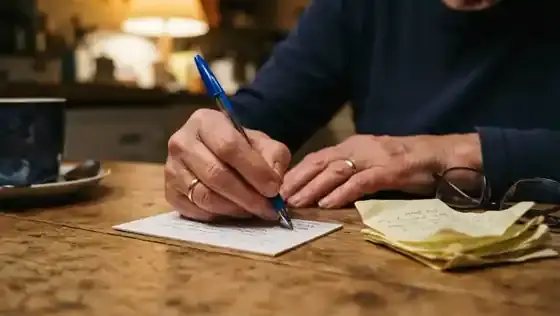
The booklet says setup takes ten to twenty minutes with a pen. It took me forty, because I'm a charge hand and I wrote the card three times.
Here's the thing a ten-line card teaches you fast. Ten lines is not very many.
You have twenty-seven sticky notes' worth of things in your life, and you get ten lines.
That turned out to be the best thing about it.
On the floor, the board was never everything; it was the things that had to happen at a time.
Everything else lived in your report sheet or your head.
So I sat at the kitchen table with the fridge door on one side and the blank card on the other, and I did triage.
A few of those lines need explaining. "Call one person" is my way around the daily-only rule.
I couldn't put "Call Carol Sunday" on a card that rings every day. So the card says "Call one person," every day at four, and on Sundays the one person is Carol.
On the other days it's Janet, or Loretta, or the cousin in Columbus I'd lost track of. I've talked to more people this summer than I had in the two years before.
"Biscuit breakfast" and "Biscuit supper" went first and last in the feeding slots, because the whole household had to agree on them. Gene and I made a rule:
whoever feeds the cat presses the button.
And "Lock back door" went in the last slot, at nine. That's the one I was really buying the clock for.
Then I took twenty-four sticky notes off the refrigerator door. I left three.
One said "Trash night = TUES," because the card can't do Tuesdays. One was the birthday list.
And one was the note that said "STAN," which I left up as a private joke with myself.
Seven Buyers, in Their Own Words, Fours and a Three Included
I'm one woman with one card.
So I went looking for what other people had said about the same clock, and I want to show you what the seller's product page actually displays, word for word.
The review panel on the product page, run through Trustpilot, showed 4.7 stars of a possible 5, from 15 reviews when I read it in October.
Here's a detail I'd put in report. Eight of those fifteen were collected by the seller itself after a purchase, and those eight average 4.4.
The other seven were imported from elsewhere, and all seven are five stars.
Fifteen reviews is not a lot. I'm telling you that up front, the same way I'd tell a new hire that the chart is thin.
None of these reviewers publish a city, and none publish a photo. The portraits beside the quotes below are illustrative, not the reviewers themselves;
the words are theirs, copied exactly, and where the original goes on longer, the gap is marked.

Great with daily reminders what to do. Easy to use
That one is short, and I like it for being short. "Daily reminders what to do."
That's the whole clock in five words.

My mom loves being able to clearly see the current day and date.
Kelly's mother and I agree on something I didn't expect. The day and the date turned out to be one of my favorite parts, and I'll tell you why in the diary.

The idea of red ticks that you press to green when you have completed the task is such a good idea, and my husband can check to see the tasks have been done.
Pamela says "red ticks"; the seller's booklet calls it orange, and on mine it reads as a warm orange. Either way, her second half is the line Gene would underline three times.
"My husband can check to see the tasks have been done."

This device helps her make sure she gets to her meals, and gives her confidence in what day of the week, it is. [...] It also automatically switched to daylight savings time, which was perfect.
Now the ones that keep me honest. A review page with no grumbling on it is a page I wouldn't trust with a nickel.

This is a great product for people with consistent daily routines. It would be really nice if it could be set up weekly and be able to include special appointments and activities. [...] But overall, a very useful tool.

The list of items should be done digitally instead of hand writing. Also the intensity of the light should be adjustable. [...] Other than this, the product is very useful.

This product was not suitable as I want to be able to insert one off appointments, not just regular reminders. I also found it to be quite clunky
Read those last three together, because they're really one review. It does daily routines, and only daily routines.
Stephanie wanted weekly. GW wanted one-off appointments and called it clunky.
Mantra wanted typing instead of handwriting, and a dimmer for the light.
They're all right. If your days are mostly appointments, this is the wrong board.
If your days are mostly the same ten things at the same ten times, it may be exactly the right one.
And Mantra's handwriting complaint is, for me, the reason I bought it. My handwriting has been on every board I've ever kept.
I trust a line I wrote myself more than any line a machine typed for me.
Calling you in two minutes. The clock just reminded me.
3:58The clock reminded you or Gene reminded you?
3:59The clock. Gene's asleep in the recliner with the ballgame on.
3:59Well, tell the clock thank you. Phone's in my hand.
4:00Ten Weeks of a Board on the Counter, Good Days and Bad Ones
I kept a diary, because that's what I do. One line a day, at the kitchen table, at nine o'clock, after the last button.
I'm going to give you the weeks honestly, including the week I unplugged it and put it in the hall closet.
Marian's diary, June to August
- Week 1Ten orange lights a day, ten presses, twenty-four sticky notes in the recycling. Biscuit fed exactly twice a day for the first time in a year. Gene called the clock "the charge desk."
- Week 2Hated the tone. Pressed buttons early to shut it up and then forgot whether I'd actually done the thing. Unplugged it Thursday and put it in the hall closet.
- Week 3Loretta came for lunch and found it in the closet. Plugged it back in, turned the volume down from the side buttons, rewrote the card: walk moved to 9:30.
- Week 4First full week with every button green by 9 p.m. Back door locked once a night, checked zero times. Called four different people at four o'clock.
- Week 6Stood at the mailbox, said "Morning, Stan" without a pause. Doesn't prove anything; I'm writing it down anyway. Tomatoes: none split.
- Week 8Grandkids for the long weekend. Buttons stayed orange half the day and nobody minded. Wrote "off the board" and didn't scold myself.
- Week 10The board is furniture now. Gene presses Biscuit's buttons without being asked.
Gene's verdict, by the way, came at the end of week one, standing at the counter with his coffee.
"It's the charge desk," he said, and then, after a moment, "I like it better than the refrigerator. The refrigerator was always mad at me."
He was right about that too. A door full of notes feels like a door full of reprimands.
A row of green lights feels like a day that went fine.
I want to slow down on week two, because it's the week most people would quit. I nearly did.
The tone was the trouble. It isn't loud, but it's a tone, and I'd spent forty years answering tones, and I'd retired partly to stop.
So I started pressing buttons early just to keep it quiet.
Then at nine o'clock I'd look at a green button and realize I didn't know if it was green because I'd locked the door or green because I'd wanted the beep to go away.
That's the oldest mistake on any floor: marking the square before the work. I'd have written up a new hire for it.
So on Thursday of week two, I unplugged it and put it in the hall closet, on top of the vacuum cleaner.
Twenty-two sticky notes went back up on the fridge by Sunday.
Loretta found it in week three.
She'd come to lunch, seen the notes, said nothing, walked to the hall closet, and come back with the clock under her arm like a bed tray.
"Volume's on the side," she said. "Two buttons.
And you don't press it until it's done. You know that.
You taught me that."
I did teach her that, in 1991, on a night I'd rather not describe. She remembered and I'd forgotten, which is exactly the kind of thing a board is for.
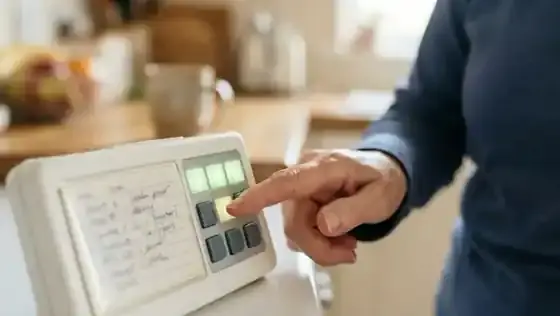
Week four is the line I'd circle. "Back door locked once a night, checked zero times."
For two years, I'd checked that door two or three times a night. Not because it was unlocked, but because I couldn't see myself locking it.
Now there was a green button. I could see that, from the hallway, in the dark.
It's a small green light, and it was enough to let me go to bed.
Week six I hesitated to include, because it's the kind of line people take the wrong way. I said "Morning, Stan" without the pause.
That's not a scientific result, and the clock didn't do it. Maybe I slept better because I wasn't getting up to check the door.
Maybe I was walking more with Gene at nine-thirty. Maybe it was just a good morning.
I'm writing it down because I write everything down, not because it proves anything.
The clock holds ten tasks.
It doesn't hold names.
Week eight, the grandkids came, and the board fell apart for three days. Buttons sat orange all afternoon while we were at the pool.
The old me would have been bothered.
The new me wrote "off the board" in the diary, because on a floor, sometimes the board goes to pieces during a rush, and you rebuild it at shift change.
At three in the morning the clock reset itself, and on Tuesday the card was right where I'd left it.
Gene doesn't write notes anymore, mostly. That one he wrote because he thought it was funny, and it is.
"Pressed it. Green."
Three words that would have saved us a pound and a half of cat.
Where the Board Actually Fits in a Day

People ask what a normal day looks like with it. So here's an ordinary Tuesday in August, from the first button to the last.
6:30. The first tone.
Biscuit is already at the bowl, because Biscuit doesn't need a clock.
I feed her and press the button; it goes green.
Gene comes into the kitchen at 6:45, looks at the green button, and goes back to the coffee pot. Nobody feeds the cat twice.
7:30. Tomatoes.
Out the back door with the watering can, back in, press.
That button used to be a sticky note that said "Water tomatoes," and the sticky note never once told me whether I already had.
8:00 and 9:00. Breakfast, then the walk with Gene.
We do the loop to the school and back, about a mile and a half, and I press the button when I'm back in the kitchen, not before.

12:00. Lunch.
This was Loretta's original reason, and it turned out to matter to me too.
On busy mornings, I'd look up at two and realize I hadn't eaten. Now a light tells me it's noon.
2:00. A glass of water.
I put that line on the card because the afternoon is when I used to drink nothing but coffee.
It's the smallest line on the card, and the one I press most gladly.
4:00. Call one person.
On Tuesdays that's usually Janet, on her drive home from work.

6:00 and 8:00. Supper, and Biscuit's supper.
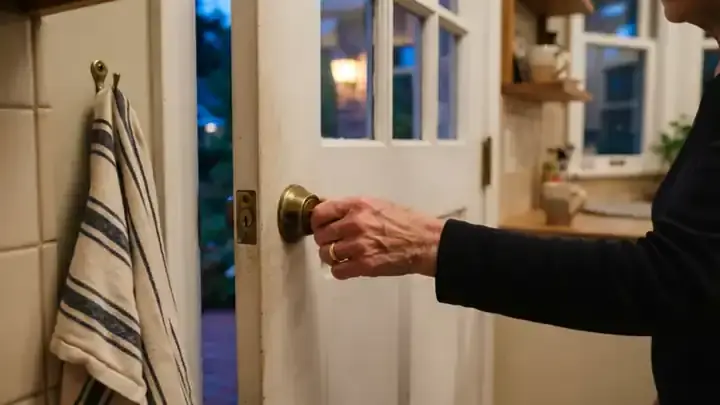
9:00. The back door.
Lock it, press it, go to bed.
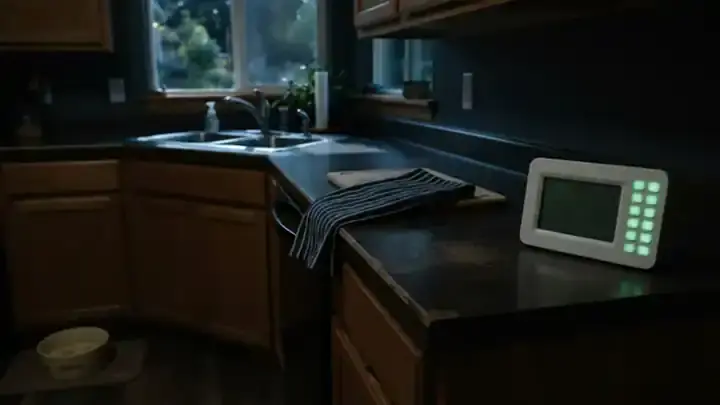
And then the board sits on the counter, ten green buttons in the dark kitchen, and at three in the morning it erases itself and waits for the next shift.
What People Said When a Short Version Ran in September
A shorter version of this column ran in September. The comments were better than the column, which is usually how it goes.
The comments below are illustrative, retold from reader notes with names shortened. Replies sit indented under the comment they answer, and they're here because they ask what you're probably asking.
Ruthanne's comment is the one I've thought about most. Two hundred dollars is a lot for a clock, and I'm not going to pretend otherwise.
I'll do the math later in this column, the way I'd do it for anybody. But the short answer is the one I gave her:
the pad of notes was cheaper, and it never once told me what was done.
And Gloria's comment is the reason I wrote this column at all. "Ordering it for my counter, not his phone."
There's a whole generation of us who'd rather keep our own board than be watched.
Short Answers to the Questions Loretta Gets at Lunch
After the short column ran, I got more letters than I've had since my retirement party. I've answered the ones that asked what most of the others asked.
The letters behind these questions are illustrative composites. The answers are mine, the same ones I'd give across the lunch table.
Short answers about the Day Hub
Does it talk?
No. At the set time a tone sounds and the button beside that task glows orange, and the task itself is written on the card in your own hand.
How many reminders can it hold?
Ten a day, at the same ten times every day. Press a button and it turns green; the whole board resets at three in the morning.
Can it do weekly or one-off appointments?
No. The seller says it isn't meant for weekly or monthly events, and three reviewers on the product page mentioned the same thing, so trash night and the dentist stay on the calendar.
Can my family change it from their phones?
No. There's no app and, in the seller's words, "no remote access feature for caregivers," and the card and the times are set on the clock itself.
Does it need Wi-Fi?
No. Wi-Fi is optional and, per the seller, only syncs the time and date and installs software updates; mine has never been connected.
What if the power goes out?
It runs on the wall plug. A small coin battery inside saves your settings during an outage, but it isn't meant to run the clock.
Is the tone loud?
There are volume buttons on the side and a volume setting in the menu, and I turned mine down in week three. One reviewer wished the light could be dimmed too.
How long does setup take?
The booklet says ten to twenty minutes with a pen. Mine took forty, because I wrote the card three times.
Can it hang on a wall?
Yes. It has a folding stand and rubber feet for a counter, and two holes on the back for hanging.
What if I don't like it?
Returns within 30 days through the seller's returns portal, with return shipping covered. The condition rules aren't published, so keep the box and call 540-405-8541 if you're unsure.
Loretta and I, Recorded for the Retirees' Newsletter
In September, the hospital's retirees' newsletter asked whether Loretta and I would let them record one of our first-Thursday lunches for their "Where Are They Now" page.
Loretta said yes before I could say no. Here's the transcript, trimmed only for the parts where we talked about people who still work there.

Where Are They Now · Retirees' Newsletter, Episode 7
Two Old Floor Hands, One Kitchen Counter and a Board That Erases Itself
Marian
host
Loretta, the newsletter wants to know why the best unit clerk the floor ever had carried a clock out of my hall closet without asking.
 Loretta
guest
Because you'd put twenty-two sticky notes back on that refrigerator, Marian. I counted them from the doorway. You trained me to count.
Marian
host
I did. Tell them why you wanted one in the first place. People think it's because something was wrong.
Loretta
guest
Nothing was wrong. Walt died, and nobody asked me if I'd eaten lunch anymore. That's all it was. My days didn't have a board, and I'd lived my whole working life by one. My boy wanted to put a camera in my kitchen. I wanted ten lines in my own handwriting.
Marian
host
And it doesn't talk. People keep asking me if it talks.
Loretta
guest
Thank goodness it doesn't. I had thirty-one years of things talking at me. It beeps, it lights up, I read my own writing. If I want somebody to talk to, I call you at four o'clock. You've got it on your card.
Marian
host
Last one. What would you tell somebody standing in front of their own refrigerator, counting?
Loretta
guest
Same thing I told every new hire. Don't mark it till it's done. And you don't have to carry it all in your head; that's what a board is for. Write it down, put it where you can see it, and go live your day.
Loretta listened to the recording afterward and asked for one correction. She wanted it on the record that she never once lost a marker on the floor, which I dispute.
I've gone back to her last line more than any other. "You don't have to carry it all in your head; that's what a board is for."
One desk clock · ten daily tasks in your own handwriting · read the return terms below first

The Return Terms and the Warranty, Read Like a Contract
Now the part most columns skip, and the part I'd have read first: what happens if it isn't for you.
Returns. The product page and the refund policy say the same thing:
returns within 30 days if you're "not completely satisfied with your order," at no charge to you, and in the seller's own words "no-hassle."
You start the return through the seller's online returns portal, which arranges the return shipping.
That's more generous than a lot of what I've read this year, where you pay to send it back.
Here's what I couldn't find.
The policy doesn't spell out what condition the clock has to be in, whether it needs the original box, or whether a card you've written on counts as used.
If that matters to you, and with a $199.99 clock it ought to, call 540-405-8541 before ordering and ask. Keep the box until you've decided.
The warranty.
The seller says its electronic products carry a 2-year warranty, and the booklet calls it a limited warranty, two years from purchase, for the original buyer, transferable with proof of purchase.
One line in the booklet I'd underline: using a power adapter that isn't the one in the box voids it.
So keep the original cord, even if you have a drawer full of chargers like we do.
Who you're dealing with.
A British company with a US store, US shipping and a phone line it lists as US customer support, plus an email address and a registered office you can look up.
That's my whole checklist for any vendor: a phone number, a return window with numbers in it and a warranty longer than the box.
Who This Clock Is For, and Who Should Skip It
I wouldn't close a report without a recommendation, so here's mine. Fair notice: half of it tells some of you not to buy.
It probably makes sense to look at it if:
- Your days run on the same handful of things at the same times: the cat, lunch, a walk, the back door
- You've got a refrigerator full of notes and no way to tell which ones are done
- You'd rather read your own handwriting than hear a voice or tap a screen
- You don't want a camera, a microphone or an app anywhere near your kitchen
- You like seeing the day and the date in big letters without reaching for your glasses
It probably isn't for you if:
- Your days are mostly appointments that change week to week; this only does daily
- You want a reminder that speaks out loud; this one plays a tone
- Your family wants to change the list from another state; there's no remote access
- You need it to know whether something was really done; it only knows a button was pressed
- $199.99 is more than a board is worth to you; a pad of notes and a pen is the honest alternative
That fourth line on the second list matters most. The clock holds the promise; you keep it.
What a Board Costs Against What I Already Spent
Now the money, because Ruthanne asked and she deserved an answer. The Day Hub is $199.99, once.
There's no subscription, no monthly plan and no app to pay for.
Divide that by the days you'd use it and it starts to look like a cup of coffee, then less.
I'm not saying sticky notes were a waste of money because the clock costs more per pad.
I'm saying the notes told me what to do, and the clock tells me what's done.
That difference was worth twenty-seven cents a day to me.
It may not be to you, and if it isn't, the pad of notes is cheaper and I'd tell you to keep it.
Where the Clock Stands, Line by Line
Here's the summary I'd clip to the front of the chart. If you only remember one part of this column, make it this one.
✓ Ten daily tasks in your own handwriting, each with a button that glows orange at the set time and turns green when you press it.
✓ The day, the part of the day, the time and the date in big letters on a 7-inch screen, with automatic daylight saving.
✓ Nothing watching, nothing listening, no app, no subscription. Wi-Fi is optional and only sets the time.
✓ A US phone line, US shipping, 30-day returns with return shipping covered, and a 2-year limited warranty.
✗ Daily only. No weekly tasks, no one-off appointments; three reviewers said so and they're right.
✗
No voice, and the screen doesn't name the task.
You read the card beside the orange button.
✗ No remote changes. Family can't update the card from far away.
✗ $199.99 is real money, the reviews number fifteen, and the return policy doesn't publish its condition rules.
If You're Standing in Front of Your Own Refrigerator, Counting
I can't tell you what to do.
I can tell you what I'd do if I were reading this column instead of writing it, back in April, with a cup of coffee and twenty-seven notes.
First, before you buy anything: take every note off the door and sort them into two piles. Things that happen every day at a time, and everything else.
Second: count the first pile. If it's more than ten, cross off until it's ten.
If it's fewer than four, you probably don't need a clock at all; a single index card on the fridge will do.
Third: for one week, write those things on a card and mark them done by hand. If you find yourself wondering whether you already did one, that's your answer.
And fourth, if the first pile is five to ten things and the wondering is your trouble: read the listing I've been describing for ten thousand words.
Ten lines, ten buttons, orange to green, $199.99, thirty days to decide.
I won't pretend a link at the bottom of a kitchen column is anything but a door to the seller's shop. Task Board Daily doesn't keep inventory; we keep boards.
But if you walk through that door, you'll know exactly what's on the other side:
a plain clock, a card in your handwriting, ten buttons, and a US phone number on the page.
One clock, ten daily tasks · keep the box until you've decided
One more thing, and then I'll let you get to your own day. The clock is on the counter between the coffee pot and the cat's bowl.
Last night at nine, I locked the back door and pressed the last button. Ten green lights in a dark kitchen.
I went to bed and didn't get up to check. That's the whole review.
This morning, Biscuit was at her bowl at 6:29, one minute ahead of the board, the way she is every morning. The tone sounded while I was already pouring.
I fed her, pressed the button and watched it go green. Gene came in at 6:45, looked at the clock, said "Good," and went to the coffee pot.
Then I walked out to the mailbox. Stan was at the end of his driveway with his paper, the way he has been every morning since 1994.
"Morning, Stan," I said.
"Morning, Marian," he said. "Your tomatoes look good this year."
They do. None of them split.
I don't know how much of that is the clock and how much is the summer, and I've stopped needing to know.
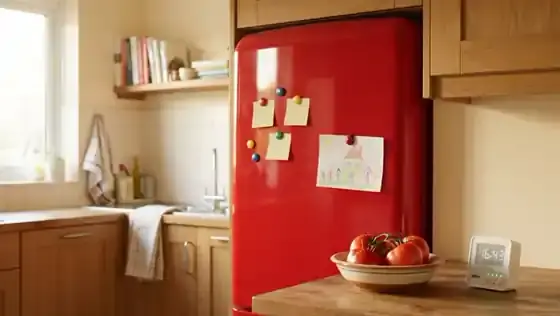
What I know is that the refrigerator door is red again, mostly. Three notes, a grandchild's drawing and a magnet shaped like a cat.
And on the counter below it, a small board that shows one thing honestly: what's been done today.
P.S. The note that says "STAN" is still on the refrigerator door, between the trash night note and the birthday list, and every morning at the mailbox I say his name out loud, which he thinks is very friendly of me.
P.P.S. If you have a Loretta in your life, the friend who reads your fridge door with her finger on each line, have her over for lunch; if you are the Loretta, bring the paperwork.
The full buyer's guide, with notes on what the clock does and doesn't do and on reading the advertising around reminder clocks, is linked at the foot of this page.
First, the people: Marian Holloway is a pen name. Gene, Janet, Loretta and the cat are composites, the way kitchen columns have always been written.
Everything about the clock itself, its features, its price, its setup and its return terms, comes from the seller's own pages, read in October 2026.